
CASE 02 · PMBOK 7 INSIGHT ESSAY
Seven ideas in PMBOK 7
that change how you see
project management.
PMBOK as a procedure manual. Tailoring as picking favorite practices. Quality as testing. KPIs as neutral observation. Project closure as the end of value. This case reframes each assumption by connecting the concepts behind it.
7 SHIFTS
Fewer terms to memorize. Better mental models to keep.
Each Map retains SourceAnchors back to the passages that support the claim.
PMBOK is not the path through the project.
Follow PMBOK in sequence and you have a project-management methodology.
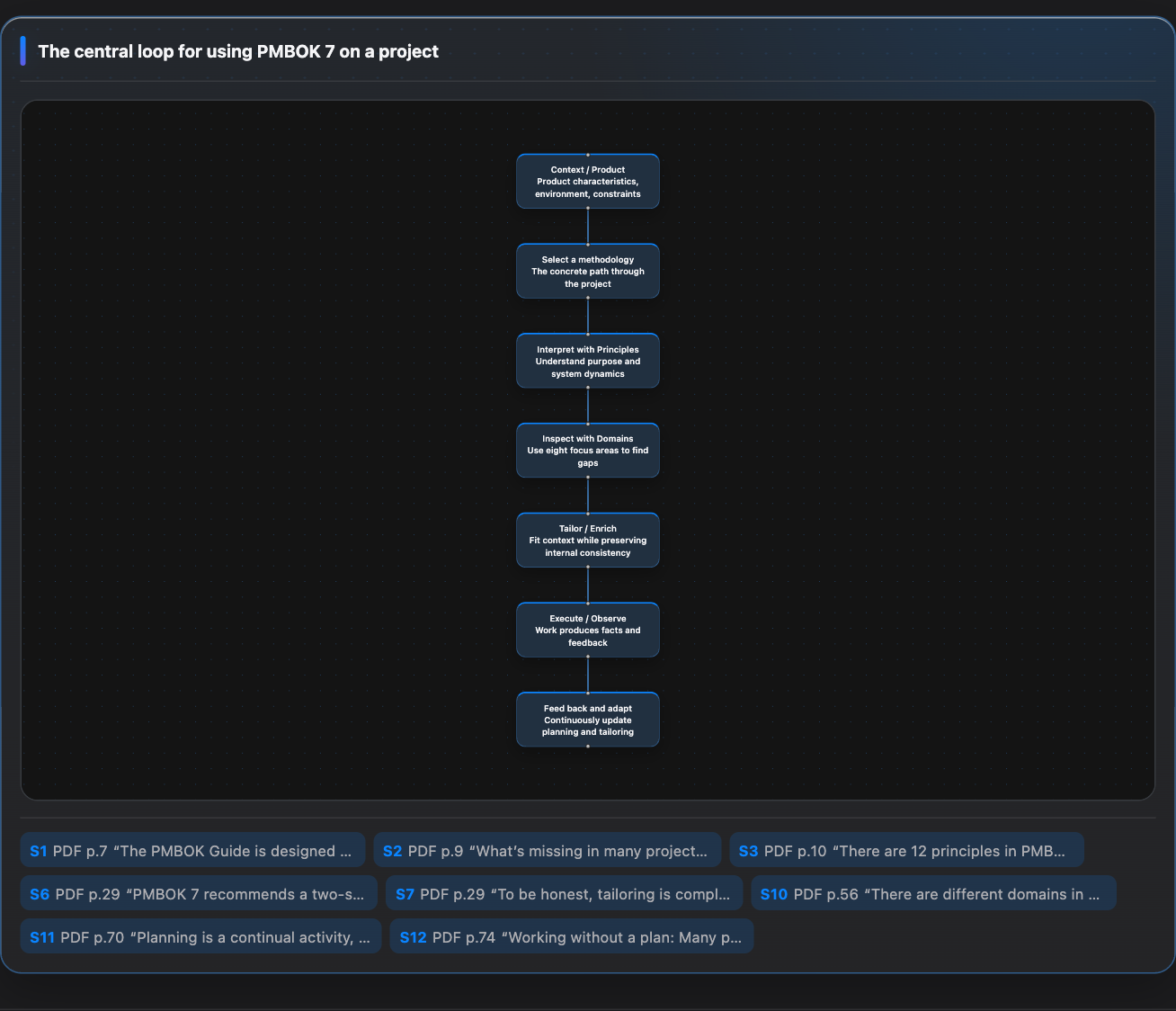
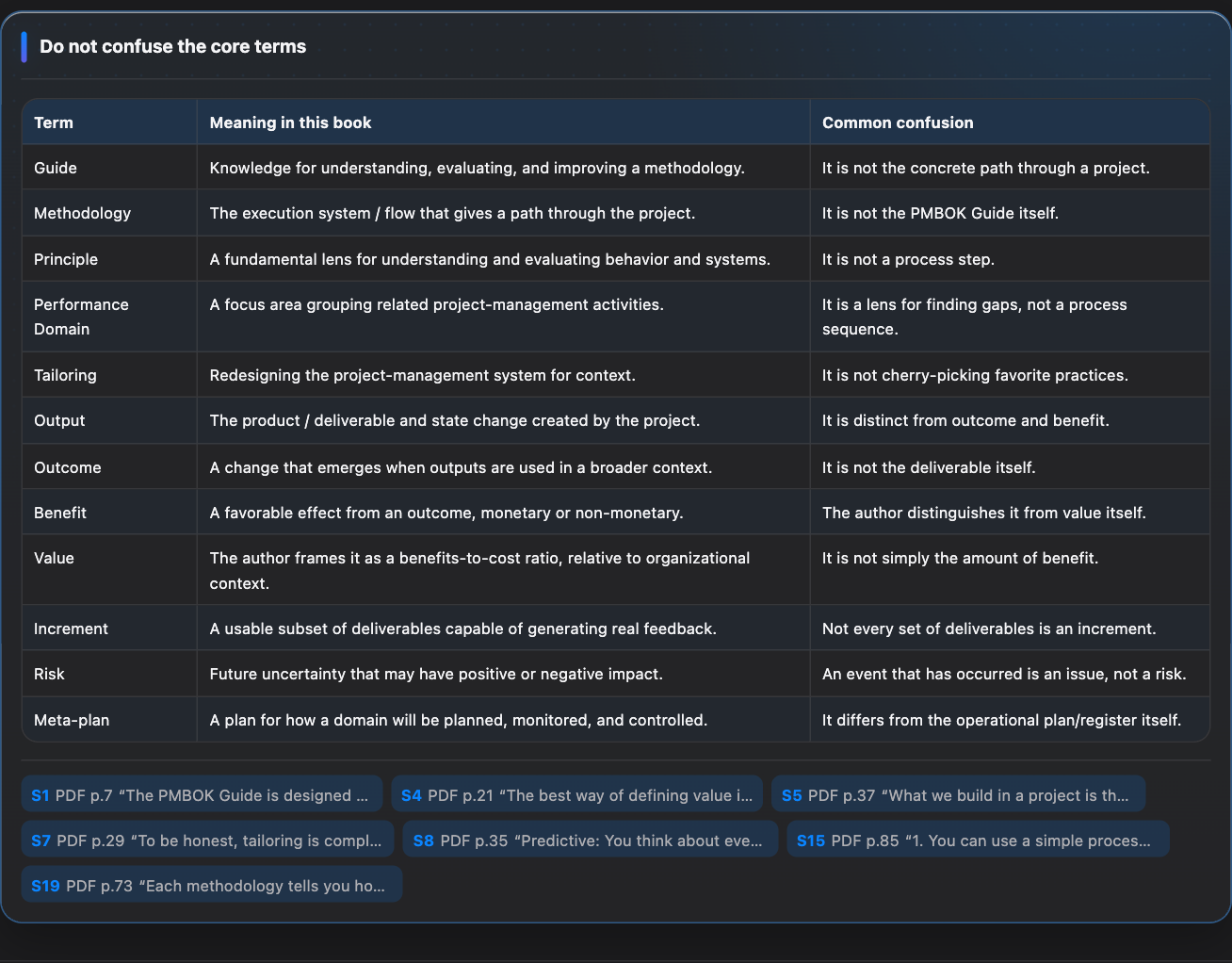
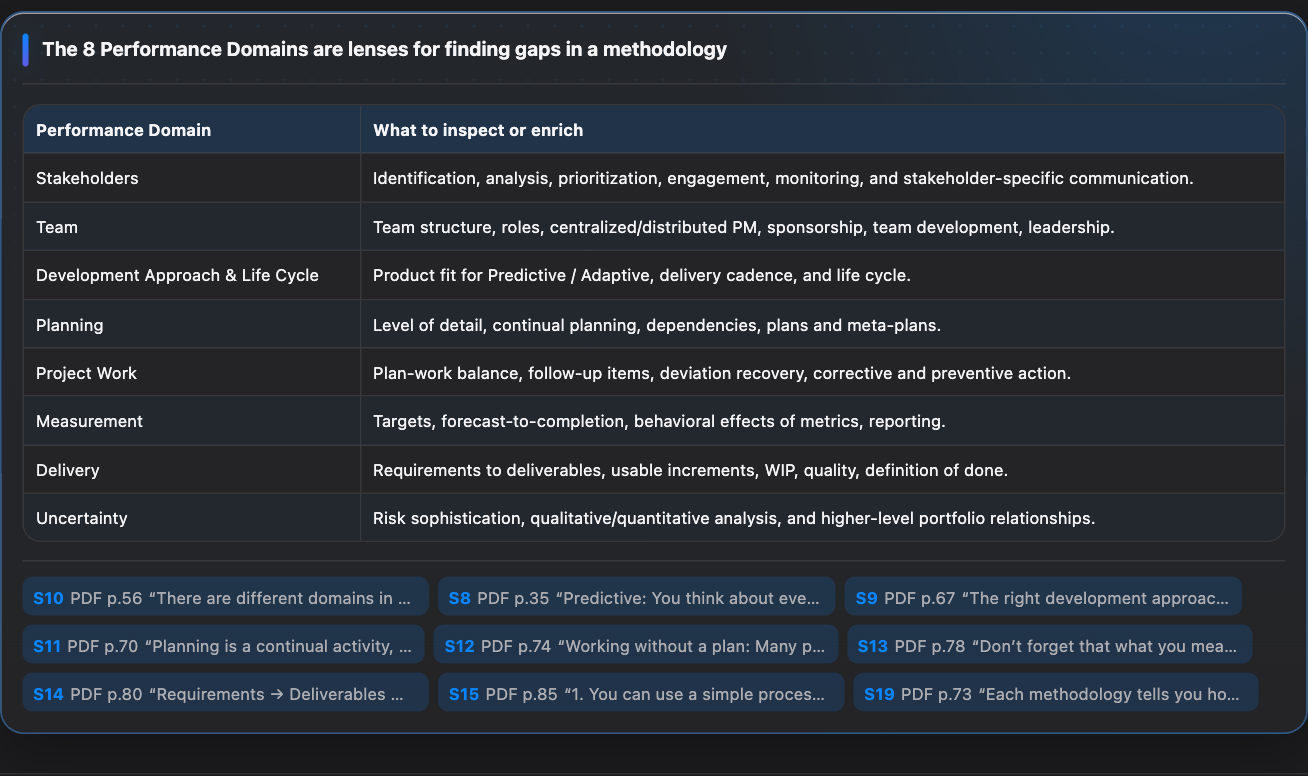
A methodology supplies the concrete path. PMBOK becomes clearer as a guide for interpreting that methodology with Principles, finding gaps with Performance Domains, and enriching it for context.
Without this distinction, Principles and Performance Domains collapse into yet another pair of checklists.
PMBOK is closer to a way of reading the map than the map itself.
Tailoring is not picking the practices you like.
Remove the heavy processes and keep the practices that feel useful.
Tailoring redesigns the project-management system for context. If you remove a practice, you also ask where its information, decision, or control responsibility moves so that the system stays coherent.
A collection of local optimizations can make the process lighter while breaking the management system.
The unit of tailoring is the system, not the practice.
Predictive vs Adaptive is a product-learning decision, not an ideology.
Adaptive is for agile cultures; Predictive is for conservative ones.
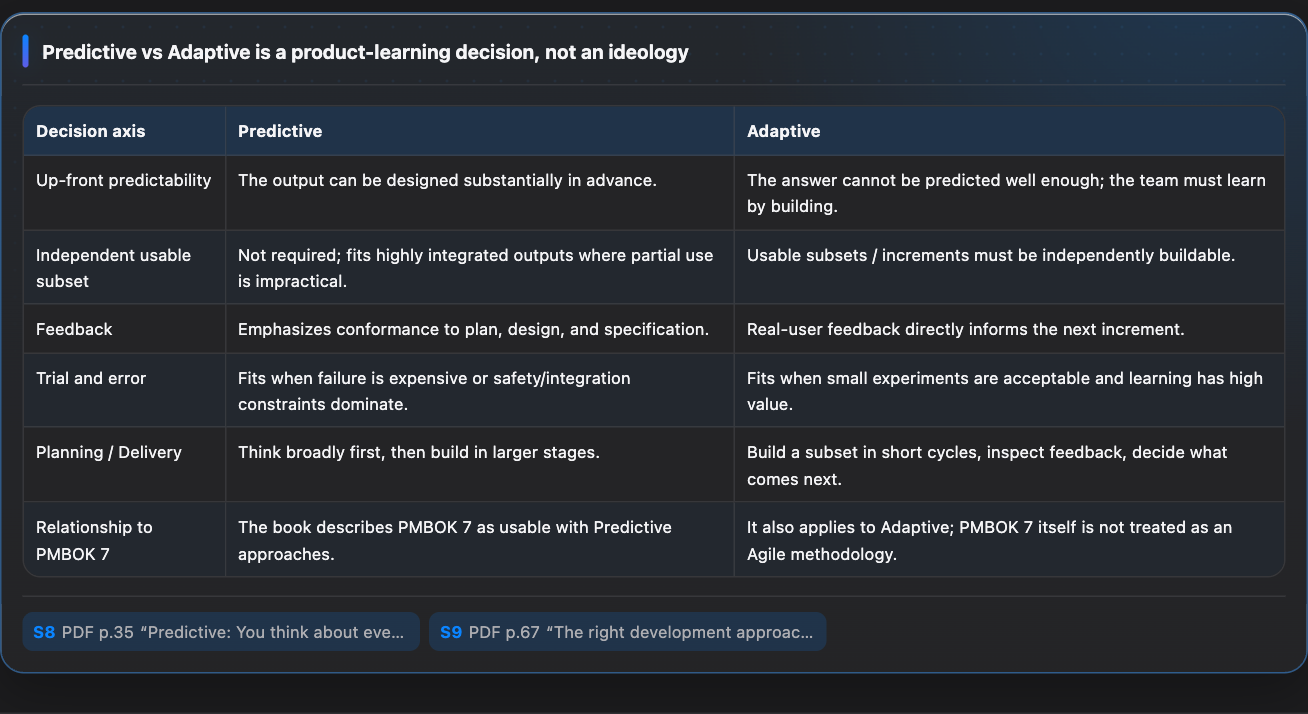
Look at product predictability, whether independent usable increments are possible, whether real-user feedback can determine what comes next, and the cost of trial and error.
You choose the development approach from the learning conditions of the product, not from organizational identity or taste.
Adaptive is less about building faster than being able to learn by building.
Quality is not the inspection phase at the end.
More testing and review means more quality.
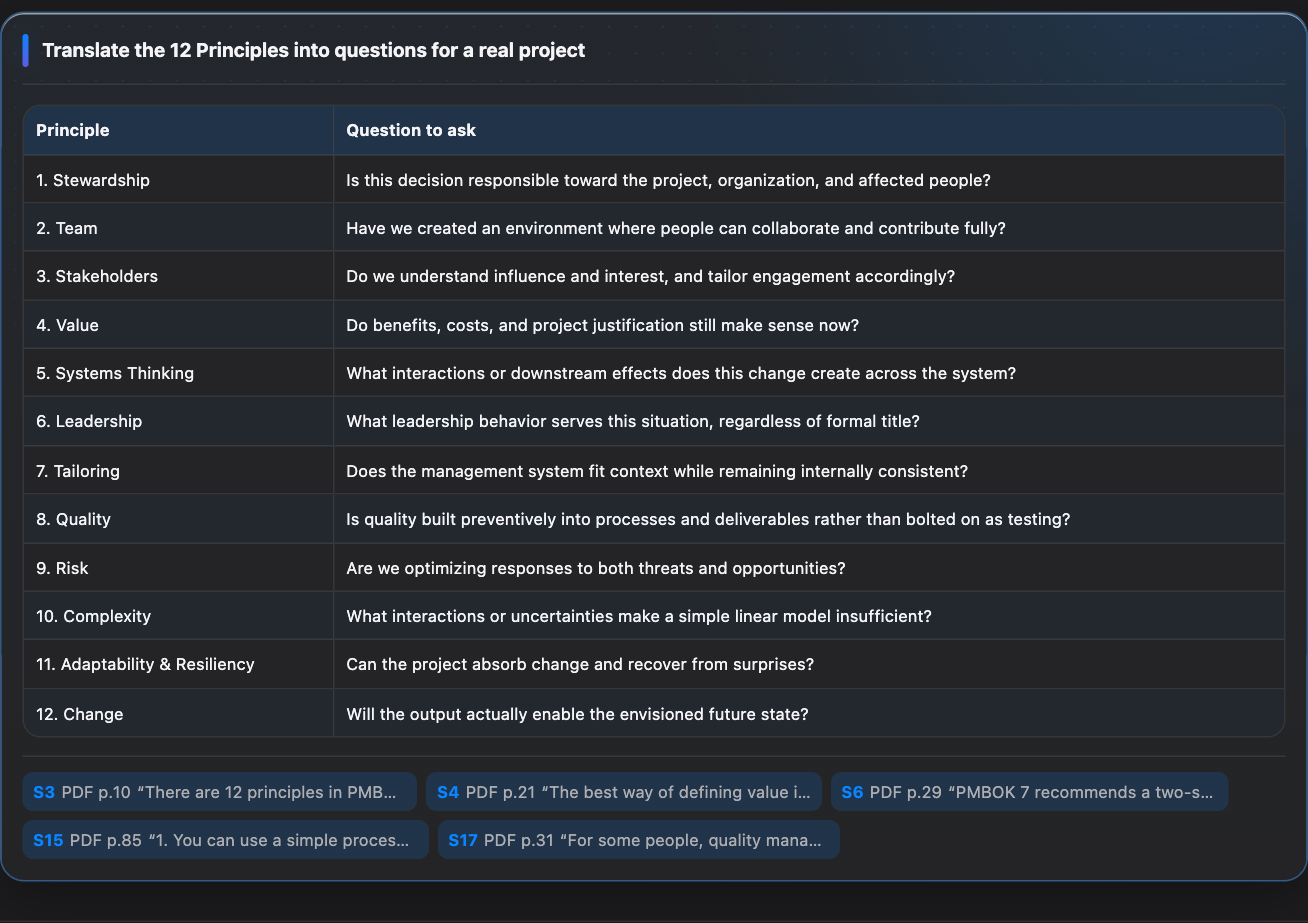
Testing finds defects. The deeper quality-management move is to design technical and management processes that prevent poor results from being created in the first place.
Quality moves upstream into design, roles, and working methods instead of relying on expensive late detection.
Quality is prevention before inspection.
Measurement does not merely observe reality. It changes it.
A KPI is a neutral thermometer for project status.
What you measure tends to become the goal and changes behavior. Measurement therefore has to design forecasts and behavioral effects, not just report the current value.
The question changes from ‘can we measure this?’ to ‘what will people optimize when we measure this?’
A metric is not only a thermometer; it is also a steering input.
Delivery should not begin with the activity list.
Start by listing tasks and building the WBS; delivery will become concrete from there.
The sequence is Requirements → Deliverables → Activities. First define what must be satisfied and what must exist for that to be true; only then decompose the work.
It becomes harder to stay busy while drifting away from the deliverable that actually matters.
Activities are a dependent variable of the deliverable.
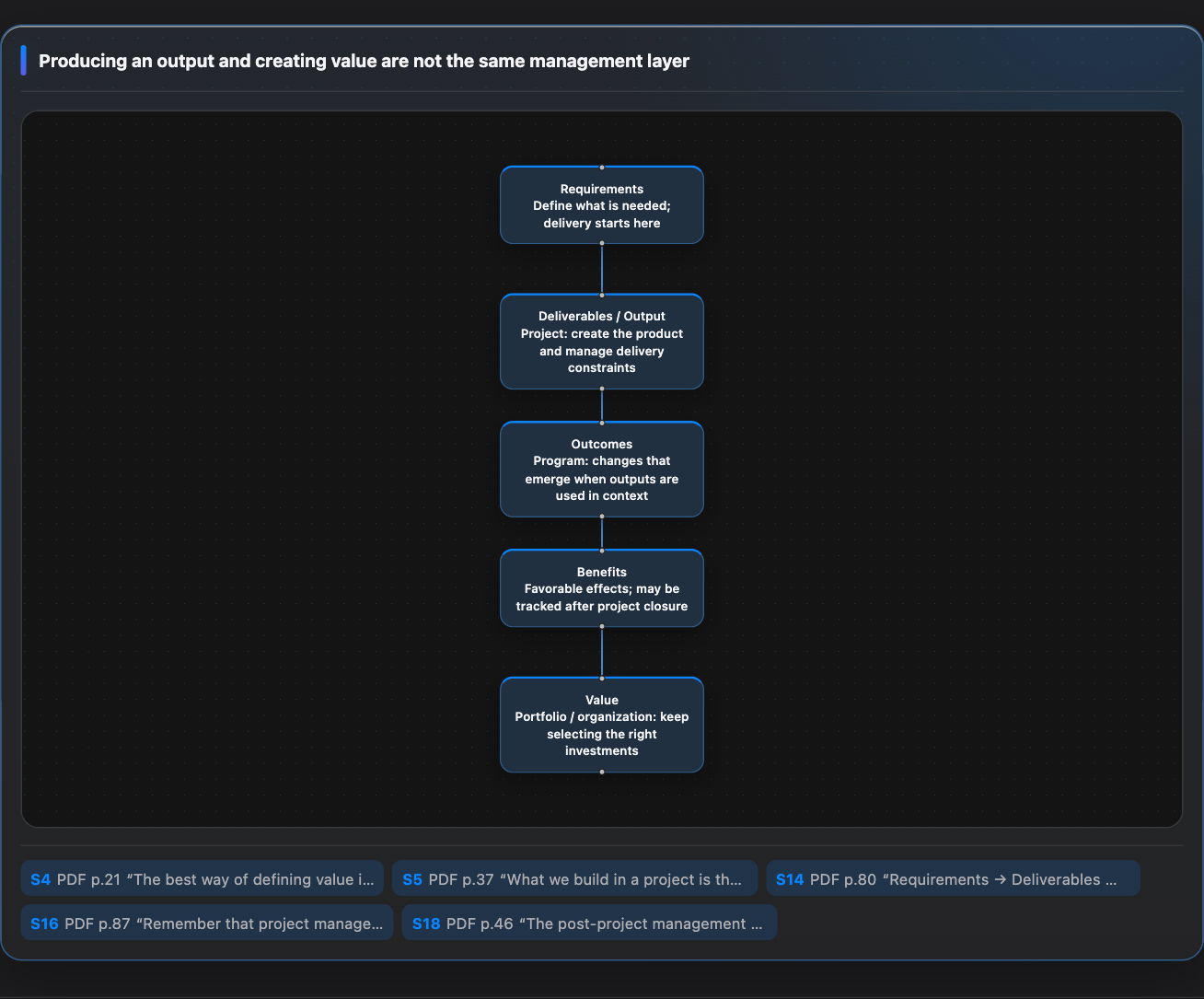
Project closure is not the end of the value story.
If scope, time, and cost are controlled and the project closes, success is settled.
The project directly produces Output. Use creates Outcomes, which can realize Benefits later. Portfolio management then asks an even broader question: are we doing the right projects in the first place?
Project efficiency and organizational value stop being treated as the same optimization problem.
Doing things right and doing the right things are different problems.
THE THROUGH-LINE
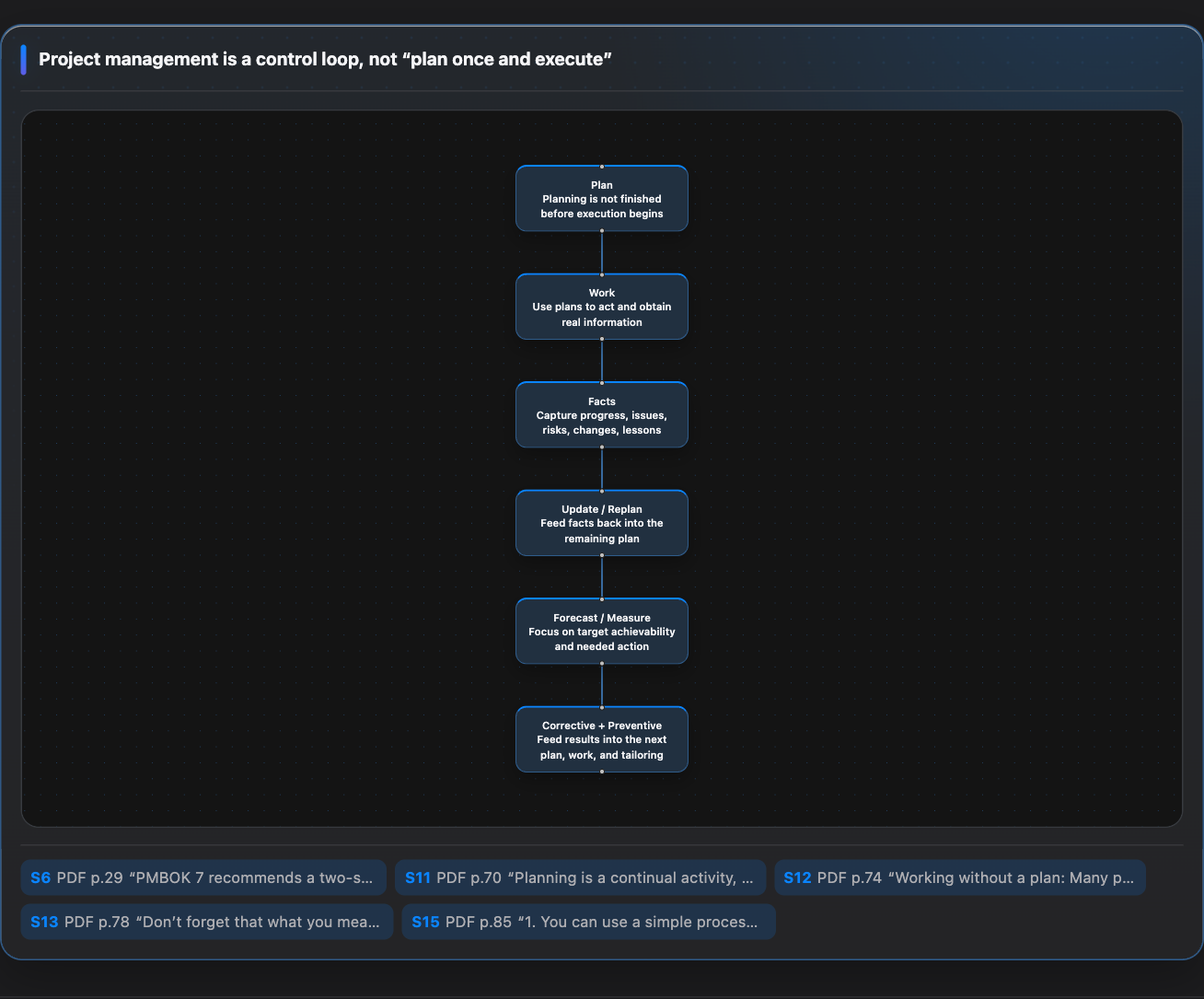
Connect the seven shifts and PMBOK looks less like a fixed procedure and more like a feedback system.
Choose a methodology for context. Use Principles to judge behavior. Use Performance Domains to find gaps. Let execution produce facts, then feed them back into Planning and Tailoring. The interesting part is not the number of processes; it is whether purpose, observation, and adaptation stay connected.
ONE INSIGHT MAP
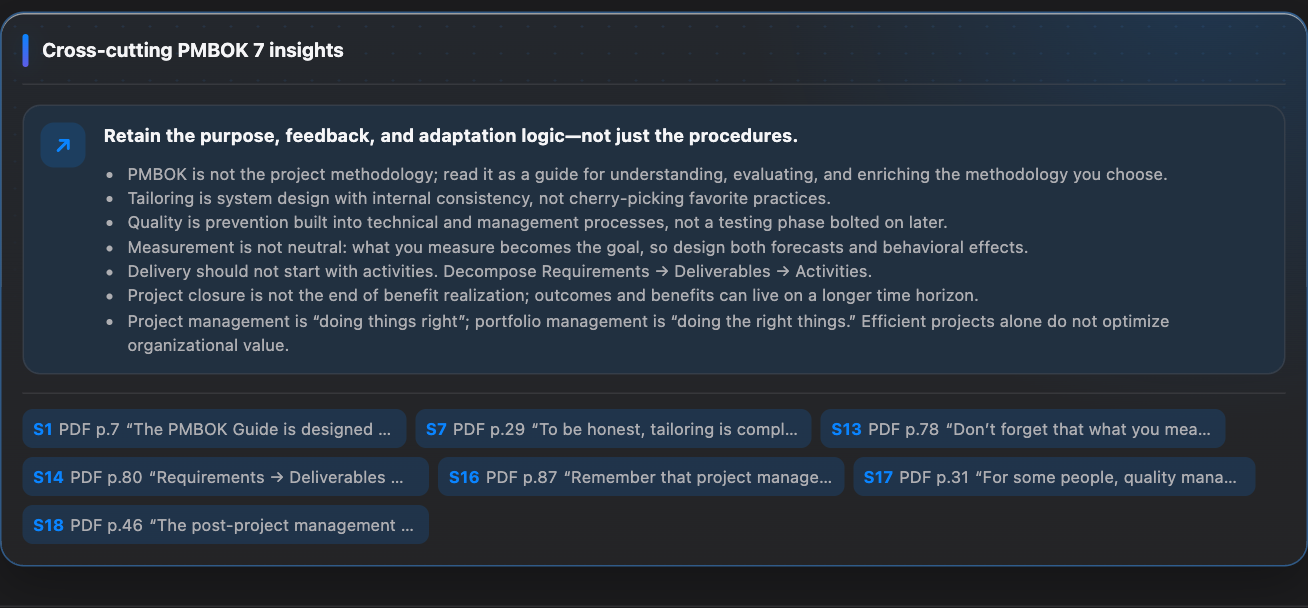
Bring the seven ideas back into one Map.
The points are not kept as disconnected trivia. They remain one grounded Insight Map whose blocks link back to the SourceAnchors supporting each claim.
View the complete eight-block MapArtifact

Source: Nader K. Rad, PMBOK® Guide 7, Underneath the Surface — CC BY. This case study draws key concepts and insights from Nader K. Rad’s interpretive guide to PMBOK 7. The book reflects the author’s personal views and is not PMI’s official PMBOK text. The synthesis and structure shown here were prepared for this Lensmap case study. PMBOK® is a registered mark of Project Management Institute, Inc.